AI coding assistants already changed how developers write software. They autocomplete functions, explain errors, generate snippets, and help engineers move faster inside an IDE.
Agentic coding is the next operating model.
Instead of suggesting the next line, an AI coding agent receives a defined objective, examines the relevant codebase, creates a plan, uses engineering tools, writes and tests code, evaluates the result, and iterates until it reaches an acceptable state: or reaches a human-controlled stop point.
For a CTO, the distinction matters. Agentic coding is not simply a better autocomplete feature. It is a change to how software delivery work moves through your engineering organization.
The practical question is not whether AI can write code. It can.
The question is whether your company can let AI execute meaningful engineering tasks with enough context, verification, security, and human accountability to improve delivery without increasing operational risk.
Agentic coding, defined
Agentic coding is goal-driven software development performed through an AI agent that can plan, act, verify, and correct its work across multiple steps.
A traditional AI coding assistant waits for a developer to ask for each action:
- “Write this function.”
- “Add a test.”
- “Fix this error.”
- “Explain this file.”
An agentic coding system works from a larger objective:
“Add multi-factor authentication for administrator accounts, update the API, add coverage for recovery flows, document the configuration, and open a pull request.”
The agent then determines which files to inspect, which patterns to follow, which tools to call, which tests to run, and which changes to make. It operates across the repository rather than inside one isolated code suggestion.
That does not make the agent accountable for the release. Your engineering organization remains accountable. The agent carries execution; your people own the decisions and gates.
What changes from AI assistance to agentic execution?
| AI code completion | Agentic coding |
|---|---|
| Suggests lines, functions, or snippets | Executes multi-step engineering tasks |
| Primarily operates inside the IDE | Uses repositories, terminals, test runners, CI, and version control |
| Responds to each prompt | Works toward a defined goal |
| Depends on continuous developer direction | Plans and acts with limited intervention |
| Produces code suggestions | Produces branches, diffs, tests, documentation, and pull requests |
| Verification is often manual | Verification is built into the execution loop |
An AI pair programmer improves the speed of an engineer who is actively writing code. An AI coding agent increases the amount of work an engineer can direct, review, and release.
That difference is the foundation of agentic software development.

How agentic coding works
A reliable agentic coding workflow follows a controlled sequence:
1. Objective
The process starts with a clearly defined outcome, not an open-ended request.
The objective should include the business purpose, technical scope, constraints, and acceptance criteria. “Improve performance” is too vague. “Reduce response time for the customer search endpoint below 300 milliseconds at the current load profile, without changing the public API” is actionable.
The quality of the objective determines the quality of the work that follows.
2. Context
The agent gathers the information required to make a safe change:
- Repository structure
- Existing implementation patterns
- Architecture documentation
- Related tickets and specifications
- Database schemas and API contracts
- Test conventions
- Dependency versions
- Security and compliance requirements
Context is not a minor detail. An agent working from incomplete repository knowledge can produce code that appears correct while violating architectural conventions or introducing hidden dependencies.
For this reason, companies adopting AI-native software development need to treat documentation, code organization, and technical standards as operating infrastructure.
3. Plan
The agent decomposes the objective into actions. It identifies likely files, dependencies, implementation steps, and verification requirements.
A human engineer should review the plan when the task affects critical workflows, shared architecture, security boundaries, or production data. Planning is where ambiguity becomes visible before it becomes code.
4. Execution
The agent uses approved tools to make changes. Those tools may include:
- Code search and repository navigation
- File editing
- Shell commands
- Build and test runners
- Linters and static analysis
- Git branches and pull requests
- CI/CD pipelines
- Documentation systems
Tool access creates leverage: and risk. An agent with broad permissions can move quickly, but it also needs strict boundaries around credentials, production systems, data access, and merge authority.
5. Verification
The agent runs deterministic checks against the result:
- Unit and integration tests
- Type checks and builds
- Linters and static analysis
- Security scanning
- Contract validation
- Regression tests
- Environment checks
Verification must be independent of the agent’s own explanation. A confident summary is not evidence that the implementation works. Passing checks, reviewable diffs, and observable behavior are evidence.
6. Iteration
If a test fails or the implementation does not meet the acceptance criteria, the agent analyzes the result, updates the code, and runs the checks again.
This loop: plan, execute, verify, correct: is what separates agentic coding from single-step generation.
Humans remain present at the gates:
spec → plan → implement → review → deploy
Automation moves the work through the system. Human judgment determines whether the work advances.

Why CTOs are evaluating agentic coding
The business case is broader than writing code faster.
More delivery capacity
A well-scoped agent can handle implementation, test creation, refactoring, documentation, and repetitive maintenance in parallel with the engineering team’s higher-value work.
Your engineers spend less time on predictable execution and more time on architecture, product tradeoffs, system behavior, and risk.
Shorter lead time
Agents reduce waiting between specification, implementation, testing, and review. They can begin work immediately once the objective and context are ready.
The advantage is not “AI works all night.” The advantage is a delivery system with fewer idle handoffs.
Greater coverage
Agents can generate tests, inspect related code paths, identify missing documentation, and apply consistent checks across a larger surface area.
Coverage still requires engineering judgment. More generated tests do not automatically mean better tests. The team must measure whether the tests validate meaningful behavior.
Repeatable engineering operations
Agentic workflows can encode how your organization works: how branches are created, how tests are required, how security scans run, how pull requests are documented, and which roles approve a release.
This makes the model useful for enterprise software engineering, where consistency and auditability matter as much as speed.
The risks are operational, not theoretical
Agentic coding increases throughput, but it also increases the volume and velocity of changes. Without control, it can scale defects as efficiently as it scales useful work.
Hallucinated or incorrect implementation
An agent may invent APIs, misunderstand business rules, or make assumptions that are not visible in the task description. Tests may pass while the feature is still wrong.
Senior review remains necessary for requirements, architecture, and system behavior.
Incomplete context
If the agent cannot access the relevant documentation, conventions, dependencies, or historical decisions, it will fill gaps with assumptions.
A clean repository and current technical documentation are prerequisites for reliable agentic software development.
Security and dependency exposure
Agents may introduce vulnerable packages, mishandle secrets, weaken authorization logic, or make unsafe infrastructure changes. Security scanning, permission boundaries, dependency controls, and a dedicated security review are non-negotiable.
Excessive autonomy
Direct production access, unrestricted shell permissions, or automatic merging creates unacceptable risk for most enterprise environments.
Agents should propose changes through branches and pull requests. CI must run before merge. Production promotion must have an accountable human owner.
Review fatigue
If agents produce more pull requests than your team can review, quality declines. The goal is not maximum agent output. The goal is a controlled increase in valuable throughput.
How to measure impact
Start with a baseline before introducing agentic coding. Then compare agent-involved work with human-only work across the same services and teams.
Use the four core DORA metrics as the primary delivery view:
- Deployment frequency: Are teams releasing more often?
- Lead time for changes: Does approved work reach production faster?
- Change failure rate: Are more releases causing incidents, rollbacks, or hotfixes?
- Mean time to restore: Does the team recover from failures faster?
Add supporting measures:
- Review cycle time
- Rework after merge
- Escaped defects
- Test coverage and test stability
- Security findings
- Agent-generated change volume
- Percentage of agent changes requiring substantial rewrite
- Developer time spent directing and reviewing agents
This is the right approach to developer productivity metrics in the AI era: measure delivery outcomes, not lines of generated code or prompts completed.
A practical adoption plan for CTOs
Start with bounded work
Choose work that is valuable, repeatable, and reversible:
- Test authoring
- Internal tools
- Documentation updates
- Small API enhancements
- Dependency upgrades
- Low-risk refactors
- Bug fixes with clear reproduction steps
Avoid starting with core payment logic, identity boundaries, irreversible data migrations, or architecture-wide changes.
Define agent-eligible work
Create explicit rules for what agents may do independently, what requires review, and what remains human-only.
For example:
- Agents may create branches and pull requests.
- Agents may run tests in isolated environments.
- Agents may not merge without human approval.
- Agents may not access production credentials.
- Security-sensitive changes require a security review.
Build the gates first
Before expanding autonomy, establish:
- Repository and tool permissions
- Required CI checks
- Static and security analysis
- Pull request templates
- Audit logs
- Rollback procedures
- Human approval ownership
Governance should be part of the workflow, not a separate committee that slows delivery after the fact.
Train engineers for direction and review
The skill is not only prompt writing. Engineers must learn to define objectives, supply context, inspect plans, challenge assumptions, and validate behavior.
This is how to build an AI-native engineering team: increase the leverage of experienced people while preserving senior engineering judgment that AI still can't replace.
The ArkusNexus operating model
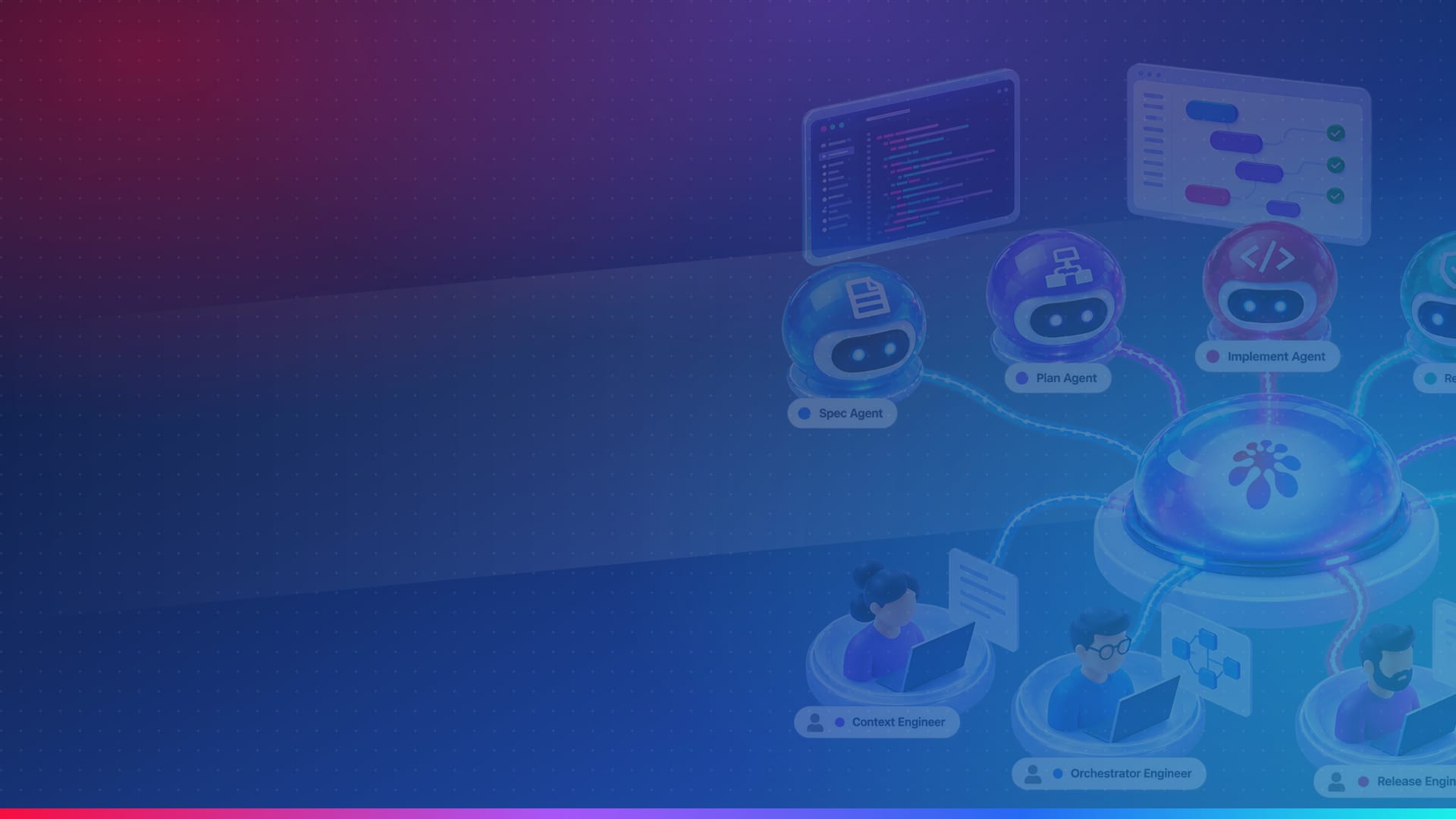
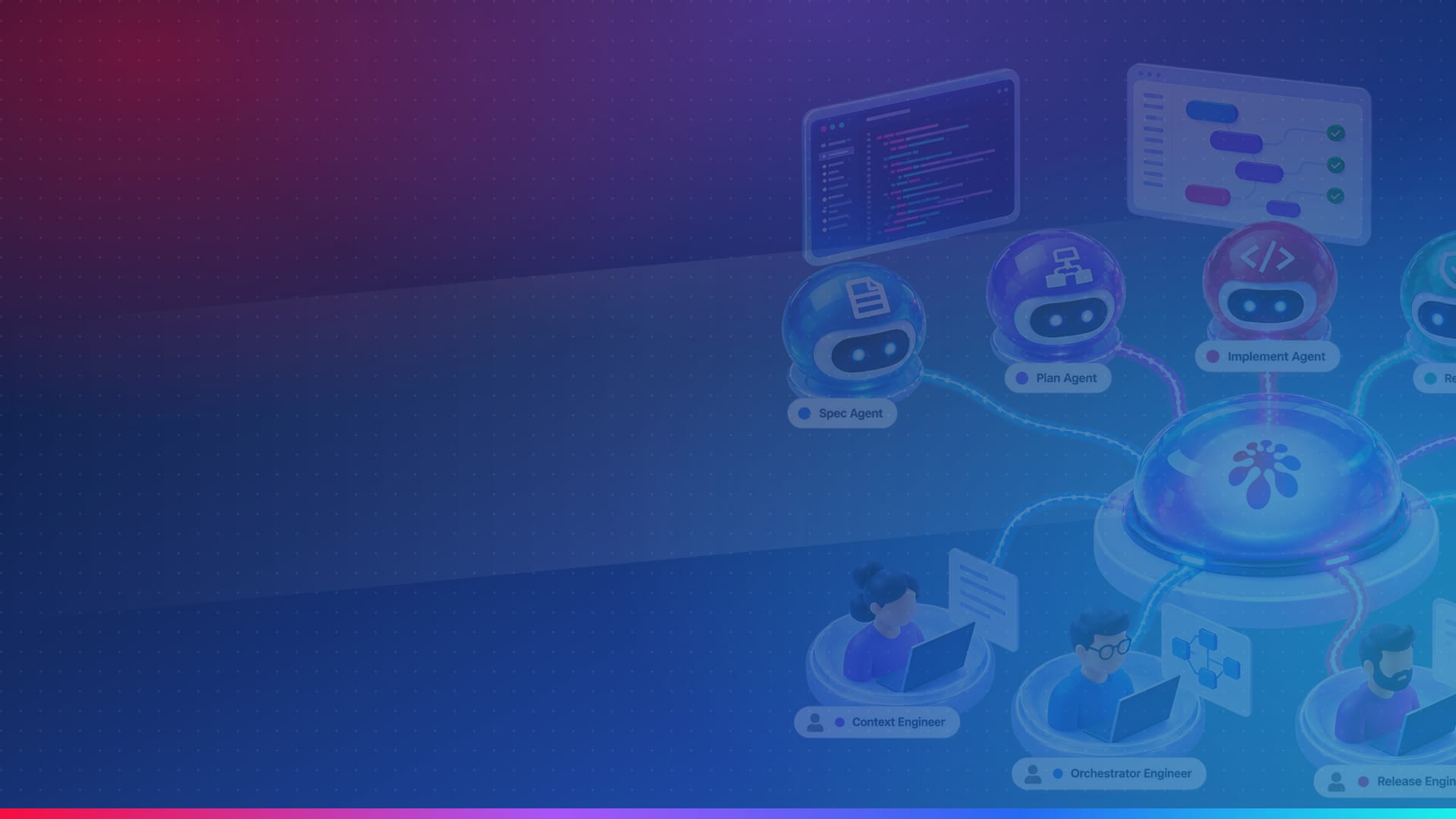
The ArkusNexus AI-Native Development Pod combines agent execution with accountable engineering ownership.
Every engineer in a Pod is a senior Product Engineer who takes a requirement from business context to release. The work covers three activities:
- Context: turning goals into a spec agents can execute.
- Orchestration: directing the agents and reading the evidence they produce.
- Release: QA, staging, rollback and production.
Security review runs across every stage and can block a release.
The Pod moves work through spec, plan, implementation, review, and deployment. Every stage has an owner. Every release has a gate. Every output includes working code, tests, documentation, and a controlled promotion path.
The result is not autonomous coding without oversight. It is a faster, more measurable delivery system where agents perform more of the execution and experienced engineers retain responsibility for the outcome.
The CTO takeaway
Agentic coding is not AI autocomplete with a new name. It is a multi-step operating model in which AI agents plan, use tools, write code, verify results, and iterate against a defined objective.
Adoption succeeds when the surrounding system is ready:
Clear specs. Complete context. Restricted permissions. Deterministic verification. Human gates. Measured outcomes.
Start with bounded work. Baseline your DORA metrics. Expand only when quality and control remain stable.
Your next engineering advantage will not come from asking an agent to write more code. It will come from designing a delivery system that lets your team direct more valuable work: without giving up judgment, accountability, or release control.
Talk with ArkusNexus about building your AI-native engineering model.